Monday, April 25, 2016

Today: National DNA Day!

Today, April 25, is the National DNA Day! The day commemorates the completion of the Human Genome Project (see PBS Nova video: Cracking the Code Of Life) in April 2003, and the discovery of DNA's double helix molecular structure in 1953 by James Watson and Francis Crick

63 years later, DNA analysis and manipulation play major roles in nearly every aspect of our lives. It opens the door for new possibilities in medical field such as preventive  medicine, pharmacogenomics, and gene therapy. With the help of computer science and technology (Bioinformatics), gene sequencing has accelerated its speed exponentially, and it's cost has also drop exponentially (even faster than the Moore's Law!). The result is that the available genomics data has grown at the rate faster than any research can handle. 

With this big amount of data, machine learning will be the best candidate technology to tackle this challenge. Machine learning has brought breakthroughs in computer vision, natural language procession, data mining in the past few years. Now, it will become a powerful tool in bioinformatics to revolutionize the field of biology and medicine. While celebrating the National DNA Day, let's start our adventure! 

Thursday, April 14, 2016

Machine Learning Applications in Biology


I visited Professor Weigang Qiu at Hunter College last Wednesday. He is leading the Evolutionary Bioinformatics Lab and his research is focusing on comparative analysis of multiple genomes of the Lyme disease pathogen. We discussed the possibility to run a research project to support high-school students conducting advanced research in bioinformatics field. I also explained to him our machine learning-related activities, and our intention to expand our research activities into the biological science. He believed that we can run projects focusing on "machine-learning applications in biology". The possible applications may include gene prediction, cancer type classification based on gene expression, and gene function prediction (e.g., Borrelia, Lyme pathogen lipoproteins). Professor Qiu will explore more in this area and come up more detailed project description for us. 

In the mean time, our focus will be in three aspects:
  1. Biology: Please review/preview chapters in your Biology/AP Biology textbook related to molecular genetics, gene expression, and genomes. If you need an AP Biology textbook, I can get one for you.
  2. Machine Learning: If you have not trained to understand the perceptron at code level, please arrange time to do it. 
  3. Bioinformatics: You also encouraged to take any MOOC bioinformatics course in the last post to build up the basic programming skill and knowledge of bioinformatics.
Please feel free to use our blog to share your study notes, programming examples, online resources, etc. You are also encouraged to invite like-minded friend to join our group.

Wednesday, March 30, 2016

Bioinformatics MOOC Courses

There are a few free bioinformatics MOOC courses:
Coursera:
  1. Biology Meets Programming: Bioinformatics for Beginners,
  2. Bioinformatics: Introduction and Methods
  3. Genomic Data Science 1: Introduction to Genomic Technologies,
  4. Genomic Data Science 2: Genomic Data Science with Galaxy,
  5. Genomic Data Science 3: Python for Genomic Data Science,
  6. Genomic Data Science 4: Algorithms for DNA Sequencing,
  7. Genomic Data Science 5: Command Line Tools for Genomic Data Science,
  8. Genomic Data Science 6: Bioconductor for Genomic Data Science,
  9. Genomic Data Science 7: Statistics for Genomic Data Science, and
  10. Genomic Data Science 8: Genomic Data Science Capstone
 
EdX:
  1. Data Analysis for Life Sciences 1: Statistics and R,
  2. Data Analysis for Life Sciences 2: Introduction to Linear Models and Matrix Algebra
  3. Data Analysis for Life Sciences 3: Statistical Inference and Modeling for High-throughput Experiments
  4. Data Analysis for Life Sciences 4: High-Dimensional Data Analysis
  5. Data Analysis for Life Sciences 5: Introduction to Bioconductor: Annotation and Analysis of Genomes and Genomic Assays,
  6. Data Analysis for Life Sciences 6: High-performance Computing for Reproducible Genomics, and
  7. Data Analysis for Life Sciences 7: Case Studies in Functional Genomics.

When Biology Meets Computer Science


Here is my on-going study notes at the entry point of this fascinating multi-dimensional space - Bioinformatics.http://prn.fm/wp-content/uploads/2015/05/DNA.jpg
  1. Genome: a full set of chromosomes; all the inheritable traits of an organism.
  2. DNA:  Deoxyribonucleic acid (DNA) is a molecule that carries most of the genetic instructions used in the development, functioning and reproduction of all known living organisms and many viruses. Most DNA molecules consist of two biopolymer strands coiled around each other to form a double helix
  3. Nucleic Acid: DNA (along with RNA) is a nucleic acid; alongside carbohydrates, lipids, proteins, and nucleic acids compose the four major macromolecules essential for all known forms of life.
  4. Nucleotide: DNA is a long polymer made from repeating units called nucleotides.
    Each nucleotide is composed of a nitrogen-containing nucleobase—either , adenine (A), guanine (G), cytosine (C), or thymine (T)—as well as a monosaccharide sugar called deoxyribose and a phosphate group.
  5. Nucleotides are summarized in the table:                                                                                                   https://blogger.googleusercontent.com/img/b/R29vZ2xl/AVvXsEg4GMr7eOQYz7S7_U9XI3Cf-rXfoc2ifGiKIuIVSc4IXVFw8mgTsN4-Nn7B9dJ5s13CyRPznsQUs9jqv_2dKS-Pcp_iN-scviwAQE4CuWXCM7MT9n7UEsE1j338QkCeIs8cwFxCnl7C3X6d/s1600/Screen+Shot+2016-03-26+at+11.55.20+PM.png
  6. Complementary nucleotidesadenine and thymine are complements of each other, as are cytosine and guanine bind to each other in DNA.                                                                                                       
    https://blogger.googleusercontent.com/img/b/R29vZ2xl/AVvXsEhGuUjRQCPs-IfXFT8AmBzRcamMEPLApBEGw_dGsaQtl472yDtiKk9BRVdak7WsVovKBoD6SzJGUBvwjvLQm8BTZVceYl4lt7uun_5AH5L-GVYQgCIyJGYvppuB-E0DkfHFhqTp1osiONdR/s1600/Screen+Shot+2016-03-25+at+6.05.40+PM.png
    Complementary nucleotides: A & T, G & C
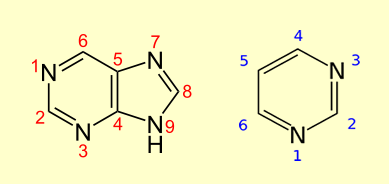
  7. Purine (C 5 H 4 N 4) and Pyrimidine (C 4 H 4 N 2) make up the two groups of nitrogenous bases, including the two groups of nucleotide bases Both purine and pyrimidine are heterocyclic aromatic organic compound.                                                                                                                                                                                      
    https://blogger.googleusercontent.com/img/b/R29vZ2xl/AVvXsEhveAX92pqWLrhNIpJ2EJl94AH_mQ2bce9U9_gbr-UXGjguU2N-pwqKZqaXyb4fzCJve51xtalKWrYREKM72Qg8jb7koVWuCH5fF8fu3BikUGK8qaKwUO-F1CscTpEbPAr_uA5F1ONkKD4_/s1600/purine+and+pyrimidine.png
    Purine (left) and Pyrimidine (right)
  8. Replication: Replication begins in a genomic region called the replication origin (denoted oriC) and is performed by molecular copy machines called DNA polymerases. Locating oriC presents an important task not only for understanding how cells re,plicate but also for various biomedical problems.
  9. Computational Analysis: To find the replication origin, computational methods are much faster than experimental approaches; in addition, the results of many experiments cannot be interpreted without computational analysis.
  10. k-mer: In computational genomics, k-mers refer to all the possible substrings of length k from a read obtained through DNA Sequencing. The amount of k-mers possible given a string of length, L, is L-k+1 whilst the number of possible k-mers given n possibilities (4 in the case of DNA e.g. ACTG) is n^k. K-mers are typically used during sequence assembly, but can also be used in sequence alignment.
    http://bioinformaticsalgorithms.com/images/Replication/patterncount.png